
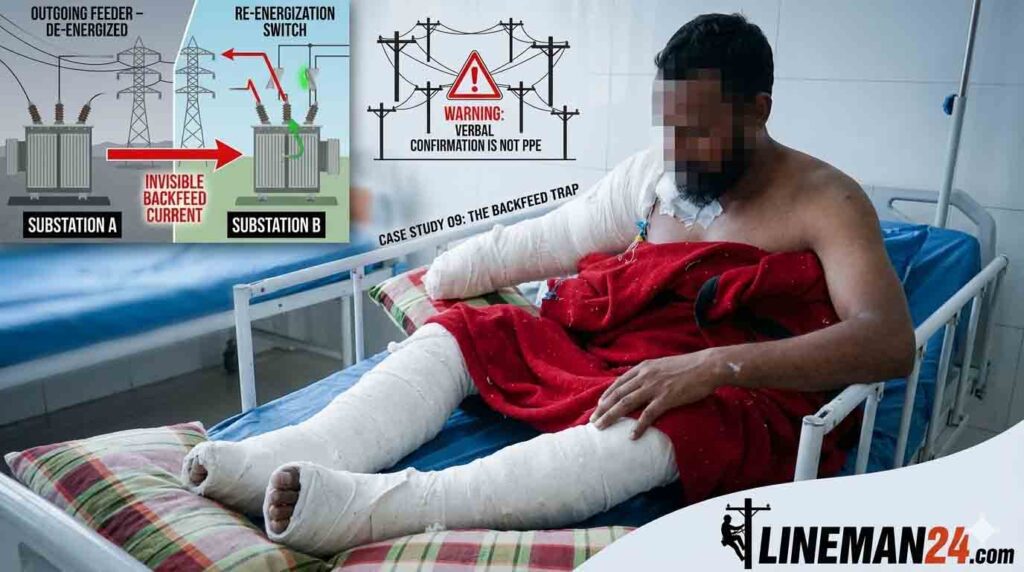
How can a hidden backfeed on a 33KV line turn a routine maintenance job into a fatal accident within seconds? This real-life electrical safety case study delivers a critical warning for every lineman, technician, and substation operator.
This in-depth safety analysis is presented by Zakir Hossain, an experienced Electrical Engineer and elite High-Voltage Lineman with over 12 years of hands-on expertise in the power sector.
In this case study, you will discover:
✔️ How a substation coordination failure escalated into a deadly incident
✔️ Why backfeed current is one of the most invisible and dangerous threats in electrical systems
✔️ How proper grounding, Lockout/Tagout (LOTO), and Test-Before-Touch procedures can save lives
1. The Incident Overview
The incident took place during a coordinated maintenance effort between two interconnected sub-stations.
-
The Coordination: Sub-station ‘A’ was performing maintenance on an 11 KV outgoing feeder and requested Sub-station ‘B’ to keep the corresponding incoming feeder dead.
-
The Fatal Mistake: While Sub-station ‘B’ initially confirmed the line was dead, a switching error or an uncommunicated re-energization occurred at Sub-station ‘B’ while the lineman at Sub-station ‘A’ was still working.
-
The Backfeed: High voltage was back-fed into the line where the lineman was working at Sub-station ‘A’.
-
The Result: The lineman at Sub-station ‘A’ was struck by the back-fed current. Due to the lack of protective grounding at the work site, he sustained severe electrocution and succumbed to his injuries.
2. Root Cause Analysis (RCA)
-
Communication Breakdown: The primary failure was the lack of a standardized and locked-out communication protocol between the two sub-stations.
-
No Local Grounding: Relying solely on a verbal “clearance” from another station without installing local grounding sets on the work site is a fatal error.
-
Lack of Verification: The victim did not perform a “Test-Before-Touch” procedure immediately before contact, assuming the line was still dead.
3. Expert Recommendations by Zakir Hossain
-
Never Trust Verbal Clearance: Always assume a line is hot until you personally verify it is dead and have established your own Local Equipotential Ground.
-
Inter-Station Lockout/Tagout (LOTO): Maintenance involving multiple stations must follow a strict LOTO procedure where all involved parties must physically sign off before re-energizing.
-
Visual Verification: Always use a high-voltage detector to confirm zero voltage before placing hands on any conductor.
“Brothers, in our world, a ‘verbal confirmation’ isn’t a safety tool—it’s a risk. This incident proves that even if you trust your coworker at the other station, you must never trust the line. Your safety is only as strong as the ground you personally install.
Don’t let your safety depend on a phone call. Own your protection. Share this study with your team and discuss your station’s LOTO protocols today. Stay safe, stay grounded, and always come home. Visit Lineman24.com for more hard-earned wisdom from the field.”
👉 Read more real-life safety case studies on Lineman24.com and build your survival instinct before your next climb.
📚 Related Case Studies:
- Case Study 10: [The Grounding Illusion – A Fatal Leap of Faith on a 33KV Line]
- Case Study 08: [The Foggy Deception – Fatal Oversight and Grounding Failure]
- Case Study 07: [The Invisible Threat – Catastrophic OCR Explosion and Maintenance Failure]
Written by Zakir Hossain
Electrical Engineer & Elite High-Voltage Lineman (12+ Years Experience)
Founder of Lineman24.com
Dedicated to saving lives through real-world electrical safety awareness.