
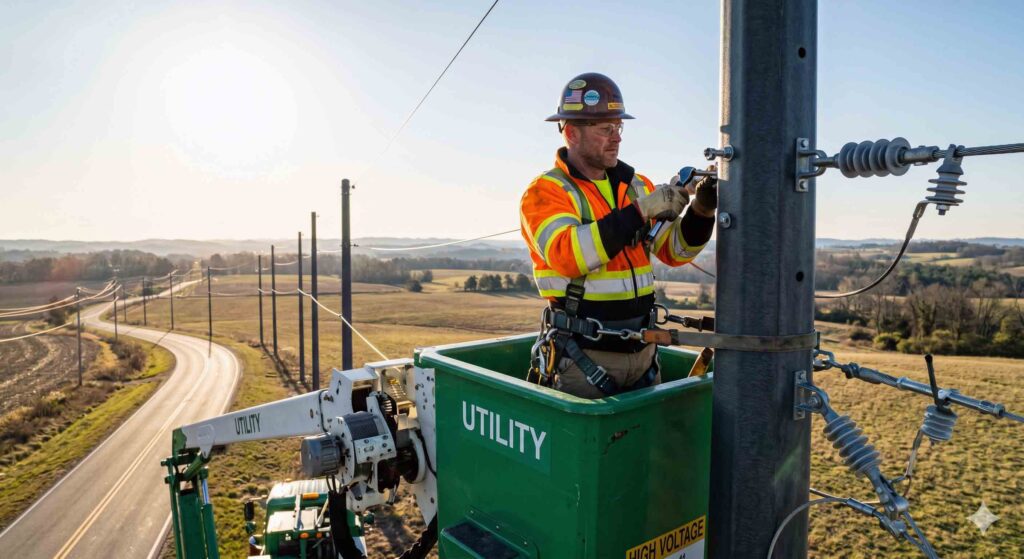
For the American lineman, late April has historically signaled the start of a grueling storm season. However, in 2026, the strategy has shifted from reactive repair to proactive Grid Hardening. With federal infrastructure grants reaching record levels this month, the industry is moving away from “fixing what broke” and toward building a network that refuses to go down. Today, we look at the technical shifts and safety protocols defining this new era of resilience.
Beyond the Splice: The Rise of Ductile Iron and Composite Poles
In the last 24 hours, utility reports from the Midwest have highlighted a massive transition in pole replacement standards. Traditional wood is increasingly being sidelined for Ductile Iron and High-Performance Composites in high-risk corridors. For the lineman, this means a shift in climbing techniques and hardware handling.
Technical Skill: Maneuvering Non-Traditional Structures
-
Climbing Gear Adaptability: As composites become the norm, mastering bucket-access and specialized strap-climbing systems is replacing the traditional gaff. These poles don’t “give” like cedar, requiring a different physical approach to vibration and load management.
-
Precision Rigging: Composite poles often feature integrated mounting points. The 2026 professional must be skilled in reading manufacturer-specific rigging diagrams to ensure that heavy transformers or smart switches don’t compromise the pole’s engineered integrity.
Safety Highlight: The Tension of the “Hardened” Line
Hardened lines often utilize higher-tension conductors and heavier-duty insulators to withstand extreme wind loads.
-
Stored Energy Awareness: When working on these reinforced spans, the mechanical tension is significantly higher. In 2026, safety protocols mandate the use of dual-rated mechanical hoists and “tension-monitoring” shackles to ensure no component reaches a snap-point during maintenance.
-
The “Whiplash” Zone: Because of the increased tension, the potential snap-back zone is larger. Crews are now trained to establish wider “exclusion zones” around tensioned conductors compared to traditional builds.
Industry News: The 2026 Resilience Training Grant
Yesterday, a major announcement from the Department of Energy (DOE) detailed a $500 million fund specifically for “Resilience Training” for journeymen and apprentices. This funding is designed to certify crews in advanced storm-hardening techniques, ensuring that the American lineman remains the world’s most skilled force in grid stability. For workers, this means more specialized certification opportunities and high-demand roles in infrastructure-heavy states.
Conclusion: Building a Grid That Doesn’t Break
Being an American lineman in 2026 is about more than just courage in a storm; it’s about the precision and technical foresight to prevent the outage before it starts. By mastering the materials and tensions of a hardened grid, we are securing the future of the brotherhood and the nation. Stay sharp, stay safe, and keep leading the charge.