
The Great Debate: Hot Sticking vs. Rubber Gloving – Which Is Your Shield?
Hey Brothers,
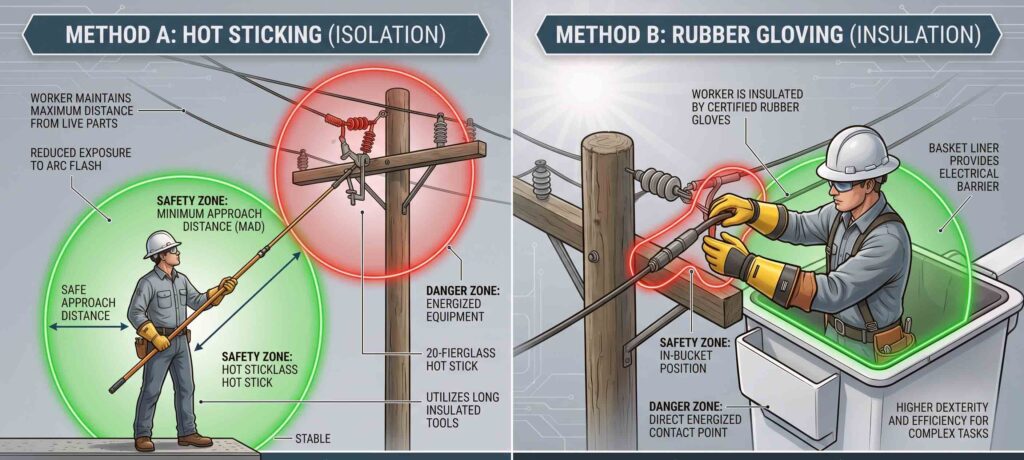
In our trade, there’s an age-old debate that happens around the tailgate: Hot Sticking vs. Rubber Gloving. Some old-school hands swear by the stick, while the modern bucket-rats prefer the dexterity of rubber. But let’s be real—this isn’t about preference. It’s about Dielectric Strength, Minimum Approach Distance (MAD), and making sure you don’t become a statistic.
Today, we’re breaking down the science of why and when you use each, with some hard math to back it up.
1. The Physics of Isolation vs. Insulation
First, let’s get our terms right.
-
Rubber gloves are insulating. You are putting a barrier between you and the energized conductor.
-
Hot Sticking is isolating. You are maintaining a physical air gap between you and the “hot” stuff.
Why does the gap matter? Air has a dielectric strength of roughly 30kV per inch (under ideal conditions). However, in the field—with humidity, dust, and smog—that number drops significantly. This is why MAD (Minimum Approach Distance) is non-negotiable.
2. The Math of MAD (Minimum Approach Distance)
According to OSHA 1910.269, the MAD isn’t just a random number. It’s calculated based on the maximum transient overvoltage.
For a standard 15kV class system (phase-to-ground voltage of approx. 8.7kV), the formula for MAD (D) includes factors for altitude and electrical movement:
(Where T is the maximum anticipated per-unit transient overvoltage, A is the altitude factor, and M is the inadvertent movement factor).
The Bottom Line: On a 15kV line, your MAD is typically 2 feet, 2 inches. If you can’t maintain that with your body, you must use a stick or be fully “insulated and isolated” (Rubber gloves + Bucket liner).
3. When the Stick is King (Hot Sticking)
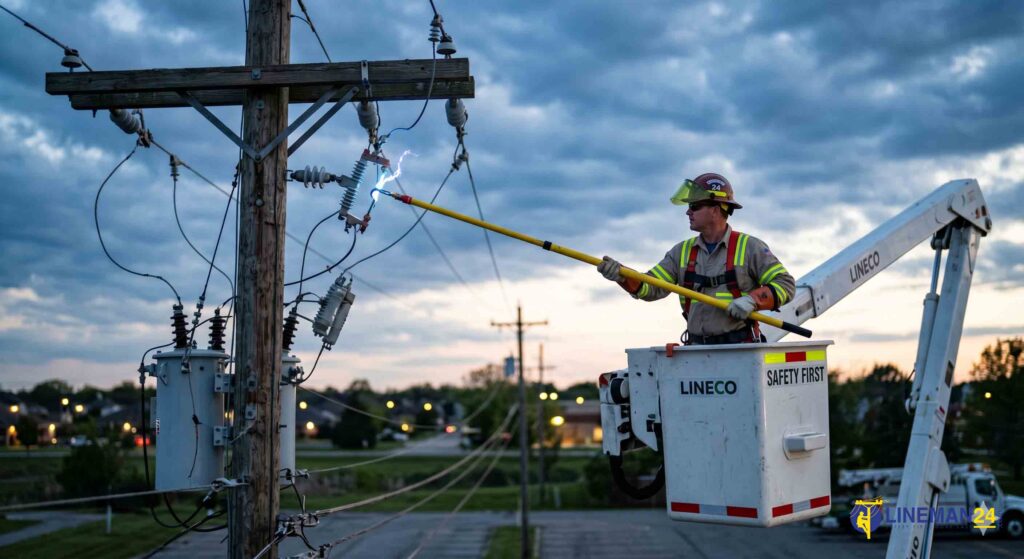
Hot sticking is generally considered safer for higher voltages (above 34.5kV) because it keeps you outside the Arc Flash boundary.
-
Mechanical Advantage: Modern telescopic sticks are made of high-grade fiberglass reinforced with epoxy resin. They are tested at 100kV per foot.
-
The Leakage Current Factor: Even a clean stick has “leakage current.” If a stick is dirty or damp, that current increases.
-
Formula for Leakage: I = V / R_stick.
-
If your stick resistance drops due to moisture, it goes up. This is why we wipe down our sticks with silicone cloths before every hot job. If you see “tracking” on the stick, put it back in the rack and tag it out.
-
4. The Precision of Rubber Gloving (Class 2 & 3)
Rubber gloving allows for faster work and better “feel,” but it places you in the “Kill Zone.”
-
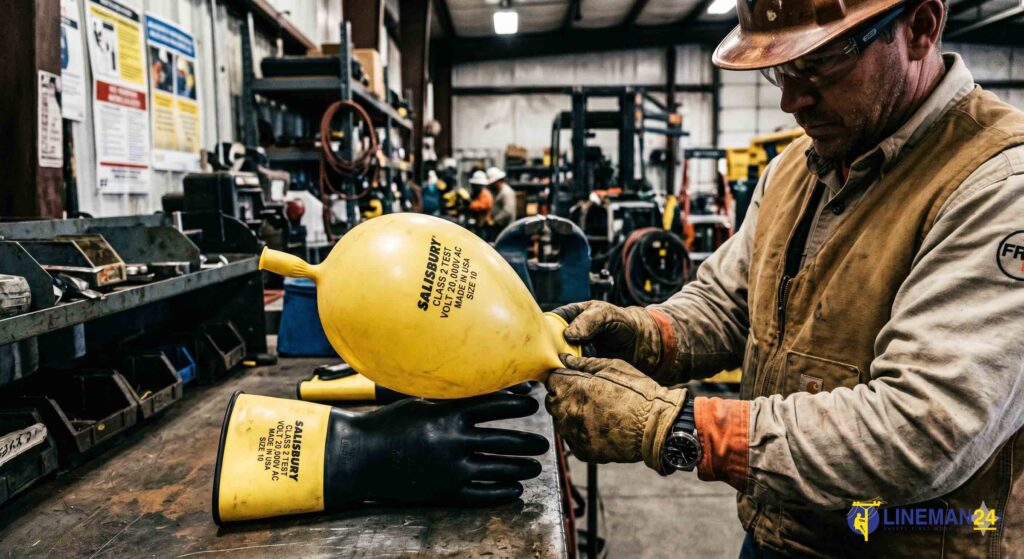
Class 2 Gloves: Rated for 17,000V Max AC. Tested at 20,000V.
-
Class 3 Gloves: Rated for 26,500V Max AC. Tested at 30,000V.
-
The Air Gap Check: Before you put them on, you air-test them. A pinhole in a Class 2 glove is a direct path to ground. If you’re sweating inside that glove, your hand becomes a perfect conductor.
5. Real-World Scenario: Changing a Dead-End Insulator
If you’re doing this with Rubber Gloves, you’re inches away from the hot phase. One slip of the wrench, or one accidental contact with a grounded crossarm, and you’ve created a phase-to-ground fault.
If you’re Hot Sticking, you’re 6 to 10 feet away. If a flash occurs, you’re outside the primary blast zone.
The Verdict
There is no “better” way—there is only the “right” way for the specific task.
-
Check the Voltage: Anything over 34.5kV? Get the sticks out.
-
Check the Environment: High humidity or rain? Rubber gloves lose their edge; stick work is safer.
-
Check your Gear: If your gloves haven’t been lab-tested in 6 months, they are just expensive balloons.
Don’t be lazy. Respect the MAD. Stay alive.
— Your Brother in the Air.
Written by Zakir Hossain
Electrical Engineer & Elite High-Voltage Lineman (12+ Years Experience)
Founder of Lineman24.com
Dedicated to saving lives through real-world electrical safety awareness.