
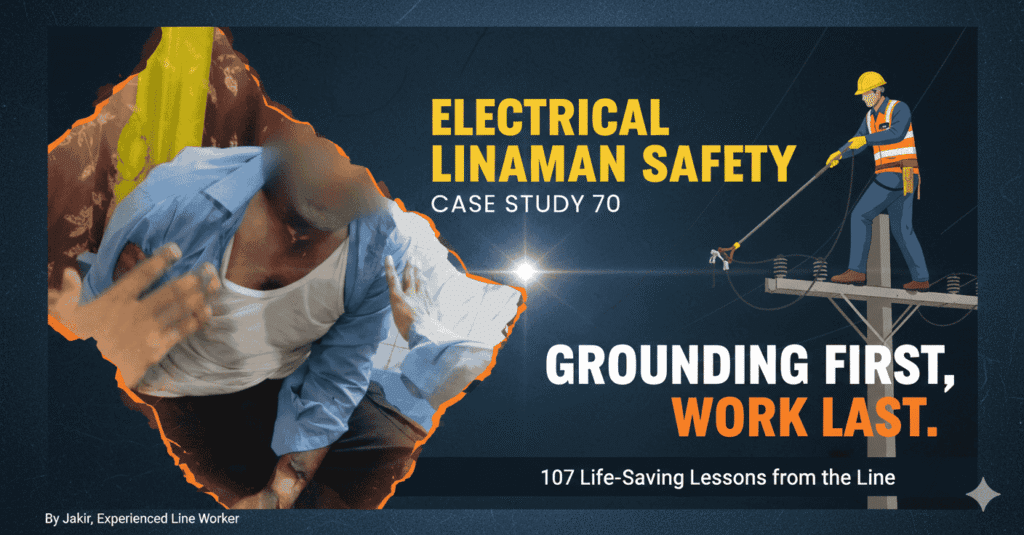
A True Story of Survival and a Warning to All Line Workers
My name is Zakir, and for the past 12 years, I have worked as an electrical lineman. This profession is more than a job; it is a high-stakes responsibility centered on electrical lineman safety, where a single mistake can be your last. I have seen many tragedies, but one incident from my own life remains etched in my heart forever
Electrical Lineman Safety Case Study: The Day Everything Went Wrong
(Based on Case Study No. 70 ) In 2017, we were assigned to install a 5 KVA transformer and four new meters. We did everything by the book—or so we thought. We took a formal shut-down from the sub-station for that specific feeder.
The Challenge: The Danger of Improper Equipment
When we reached the site, we realized we didn’t have an office ladder. Under pressure to finish the work, we used a small ladder from a customer. It was too short to reach the cross-arm. To compensate, one of our brave linemen had to climb the pole using a hand-line rope for support.
The Accident: A Split-Second Flash on a Live Line
⚠️ Trigger Warning: Caution: Graphic image of work-related injury used for educational purposes

As he sat on the cross-arm to perform temporary grounding by hand (as we lacked a shotgun/safety stick), a massive, blinding flash occurred. The line wasn’t dead. In a split second, he lost consciousness and slumped over the pole.
For ten terrifying minutes, he hung there. Down below, we were helpless, piling straw at the base of the pole, praying he wouldn’t fall. Miraculously, he regained consciousness, screaming, “Brother, where am I?” We rushed him to the hospital, and though he survived, his body was severely burned.
The Silent Killer: Communication Gaps and Energized Feeders
We later found out that the feeder had been shifted to another sub-station just a few days prior. Our sub-station operator had no idea the line was still energized from a different source.
Critical Lessons for Survival and Safety Protocols
This incident taught me that even a “confirmed” shut-down is not enough. To stay alive, every line worker must follow these non-negotiable steps:
-
Grounding First, Work Last: Never touch a wire until it is properly grounded.
-
The Shotgun Rule: Never attempt grounding with your bare hands. Always use a safety stick (shotgun) to keep your distance from potential flashes.
-
Verify, Don’t Assume: Use a voltage detector to confirm the line is dead. Communication gaps between sub-stations (like the one we experienced) are common and deadly.
-
Safety Gear is Not Optional: Lack of proper ladders or equipment should never be a reason to bypass safety protocols.
A Final Word to My Brothers: Work Safe, Stay Grounded
In countries like Bangladesh, we lose 10 to 15 brothers every year to electrical accidents. Most of these could be avoided if we simply refused to work without proper grounding.
Your family is waiting for you at home. Don’t let a moment of haste turn into a lifetime of regret. Work safe, stay grounded.